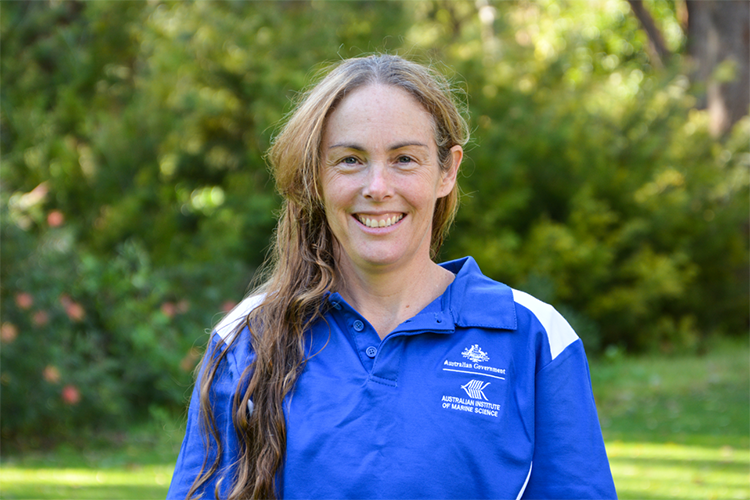
Dr Rebecca Fisher
Australian Institute of Marine Science | Ecological Risk Assessment Modeller
Rebecca Fisher is a quantitative ecologist at the Australian Institute of Marine Science, with over 25 years in marine ecology and more than 100 peer-reviewed papers and technical reports. Her work sits at the interface of ecology, numerical modelling and quantitative decision science, most recently in statistical ecotoxicology and the handling of uncertainty in environmental risk management. She is an author or contributor to the R packages ssdtools, bayesnec, epower, FSSgam and ElicitN, and co-led the joint Australian–Canadian investigation that led to ssdtools being adopted as the default software for deriving water quality guideline values.
Abstract
Setting the legal limit with an R package: fifteen years of open-source software in environmental regulation
Environmental regulation runs on numbers: the turbidity trigger that stops a dredge, the concentration limit in a discharge licence. They have to be defensible — to a regulator, to a proponent, occasionally in court — and increasingly they come out of open-source R packages. I am a quantitative ecologist at the Australian Institute of Marine Science, with a sound applied grasp of statistics and no formal training in programming. This talk traces fifteen years of accidental software development around one question: how far did the software travel?
Era one produced scripts, not software. ElicitN, published in 2012 with four co-authors, was 57 R scripts in a zip file, and effectively unreproducible within five years. None of us thought to ask whether it would still run.
Era two ran as two strands that never met. One was industry monitoring data — over 1,500 coral colonies scored fortnightly for 530 days — producing thresholds still in regulatory use, and code entangled with data I cannot distribute. The other was GitHub and packaging, FSSgam and epower: installable, public, and depended on by no regulation at all. The pattern is backwards. The higher the stakes, the less shareable the tooling, and I do not think our field has solved this.
Era three was CRAN, and then ssdtools: jointly evaluated by Australian and Canadian regulators and adopted as the default for deriving water quality guideline values in three countries. Open source was the precondition for that agreement, because three regulators cannot audit a black box. It closes on the last few months. I stopped writing code by hand in June. Rather than assert a productivity gain I measured it across 1,340 of my own commits, and will show where the change actually is — it is not in the typing.