Making disease models easy to access, transparent and visual
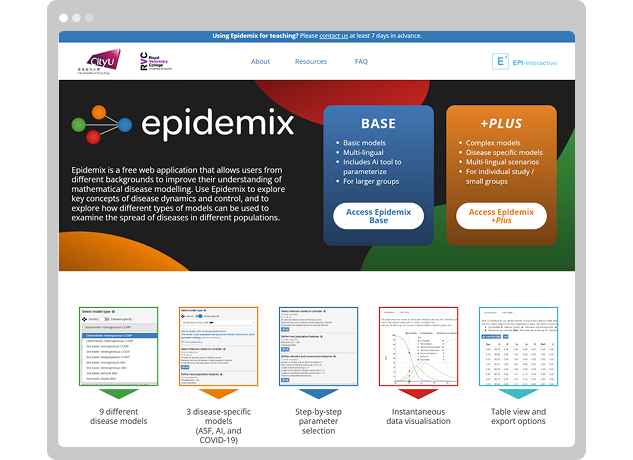
Disease models are often complex and challenging to communicate. Epidemix makes disease models accessible, removing the barrier of dealing with mathematical equations and programming language to empower students, teachers, researchers and policy makers to better understand disease spread and the impact of different interventions.
Supporting evidence-driven decision making
Compartmental models are a commonly used tool to describe the spread of disease and impact of interventions. Taking these complex mathematical models from scientific data to actionable insights requires a high level of technical expertise, limiting the accessibility for most audiences. Epidemix empowers users to improve their understanding of key concepts of disease dynamics and control, without having to directly deal with mathematical equations and programming language. The app makes it easy for users to follow the links between model outputs and underlying assumptions.
Making complex models widely accessible
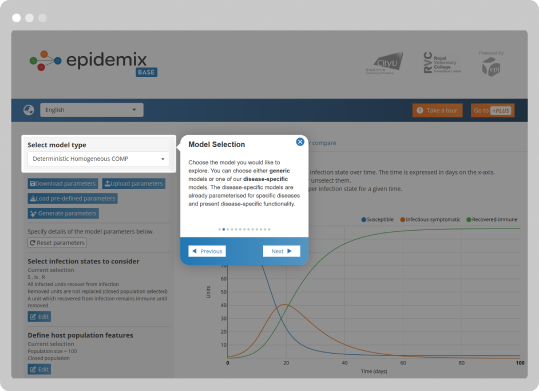
To ensure disease models on the dashboard were easily digestible and accurately communicated complex scientific data we collaborated closely with researchers at the Royal Veterinary College and the City University of Hong Kong. At each step, explanations of the models and parameters included in Epidemix are just a mouse click away for the user. Scenario exercises for disease models are available in multiple languages, removing language barriers and allowing the app to be used by a global audience.
''...we are using Epidemix for educational purposes to demonstrate the role of models, explain the principles of modelling, its potential use, the interpretation of results and more. Epidemix has been a fantastic tool helping us communicate key concepts of modelling to policymakers."
Prof. Andres Perez
Director of the Center for Animal Health and Food Safety at the University of Minnesota
"The tool has been accessed by users in more than 140 countries, with more than 5,000 unique users accessing the app in 2021 alone."
Read the full Epidemix case story in Making Impact from the One Health Poultry Hub.
Linking science and policy
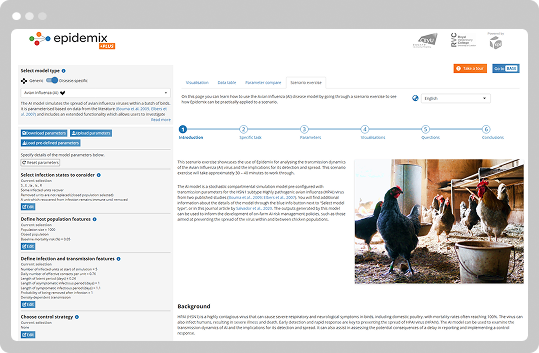
The flexibility of Epidemix allows us to quickly add models for specific diseases – models for COVID-19, Avian Influenza and African Swine Fever (ASF) are already implemented. This takes Epidemix from theory to practice creating the critical connection between science and policy, strengthening efforts to reduce the spread of these diseases and protect human and animal health. Epidemix has for example been used in the World Organisation for Animal Health’s (WOAH) Compartmentalisation Guidelines for ASF.
AI as a tool to explore disease dynamics
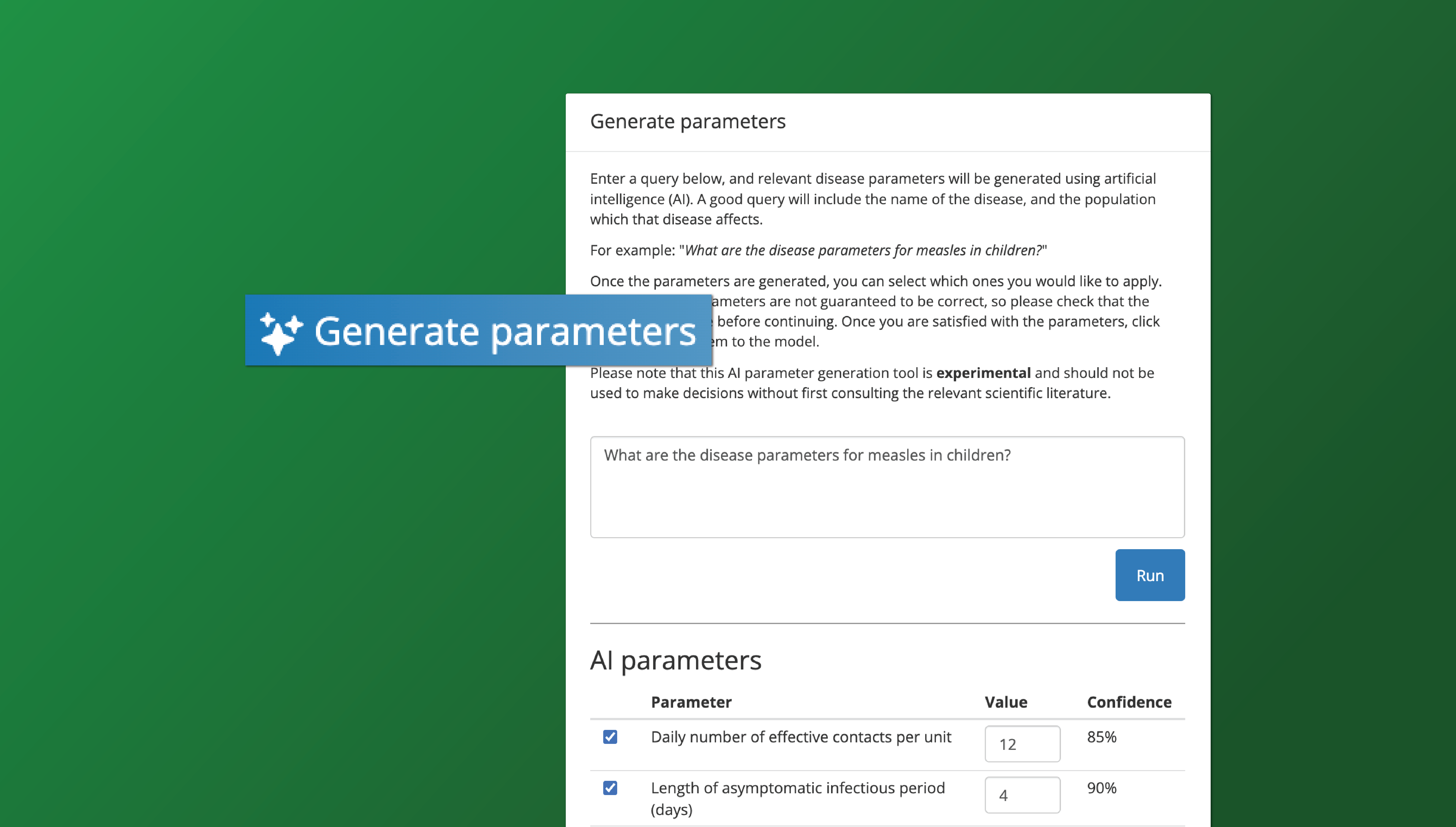
Integration of artificial intelligence into Epidemix enables the app to generate disease parameters specific to the transmission dynamics of a disease of interest. Users can simply ask the app to research values for parameters of a specific disease, and the app will propose values which, following review, can be used to populate a model of choice and explore their effect on model outputs such as the number of infected and symptomatic individuals.

Intuitive exploration
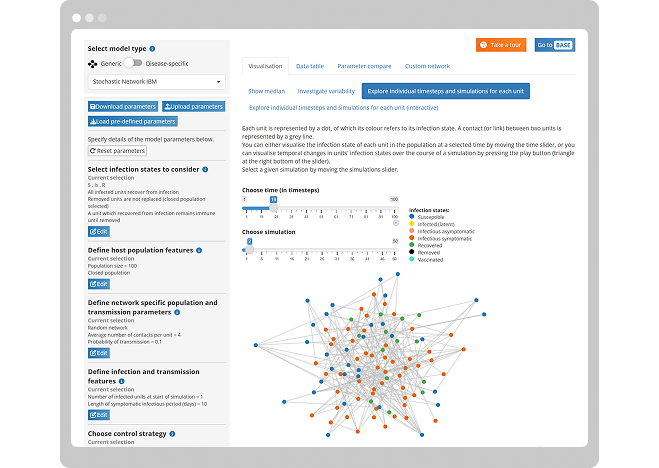
In designing Epidemix attention was paid to the wide range of users who would be interacting with the interface – from students to researchers and policy makers. Through several rounds of review, we developed a user-friendly interface which makes it easy to compare the impact of different parameter settings, such as the length of the asymptomatic period or percentage of the population that is protected by a vaccine on disease spread. To better define basic and complex models and functionalities without overwhelming users, the application was split into two platforms, Base and Plus. This ensures that the dashboard interface is tailored to the needs of the user.
Presentations
Muellner P, Fournie G, Muellner U, Yang L, Pfeiffer D. Taking the black box out of disease models to improve their use and interpretation – fool’s dream or a new frontier? One Health Aotearoa (OHA) Symposium, New Zealand, 2020.
Muellner U, Fournié G, Muellner P, Ahlstrom C, Pfeiffer D. Epidemix – an interactive application teaching the ins and outs of infectious disease modelling. Australian and New Zealand College of Veterinary Scientists (ANZCVS) Science Week, Surfers Paradise, Australia, 2016.
Fournie G, Muellner U, Muellner P, Ahlstrom C, Pfeiffer D. epidemix-An interactive multi-model application for teaching and visualizing infectious disease transmission. Proceedings of the 15th Symposium of the International Society for Veterinary Epidemiology and Economics (ISVEE), Chiang Mai, Thailand, 2018.
Publications
Muellner U, Fournie G, Muellner P, Ahlstrom C, Pfeiffer D. Epidemix - an Interactive Multi-Model Application for Teaching and Visualizing Infectious Disease Transmission. Epidemics, doi: 10.1016/j.epidem.2017.12.003, 2017. Available here